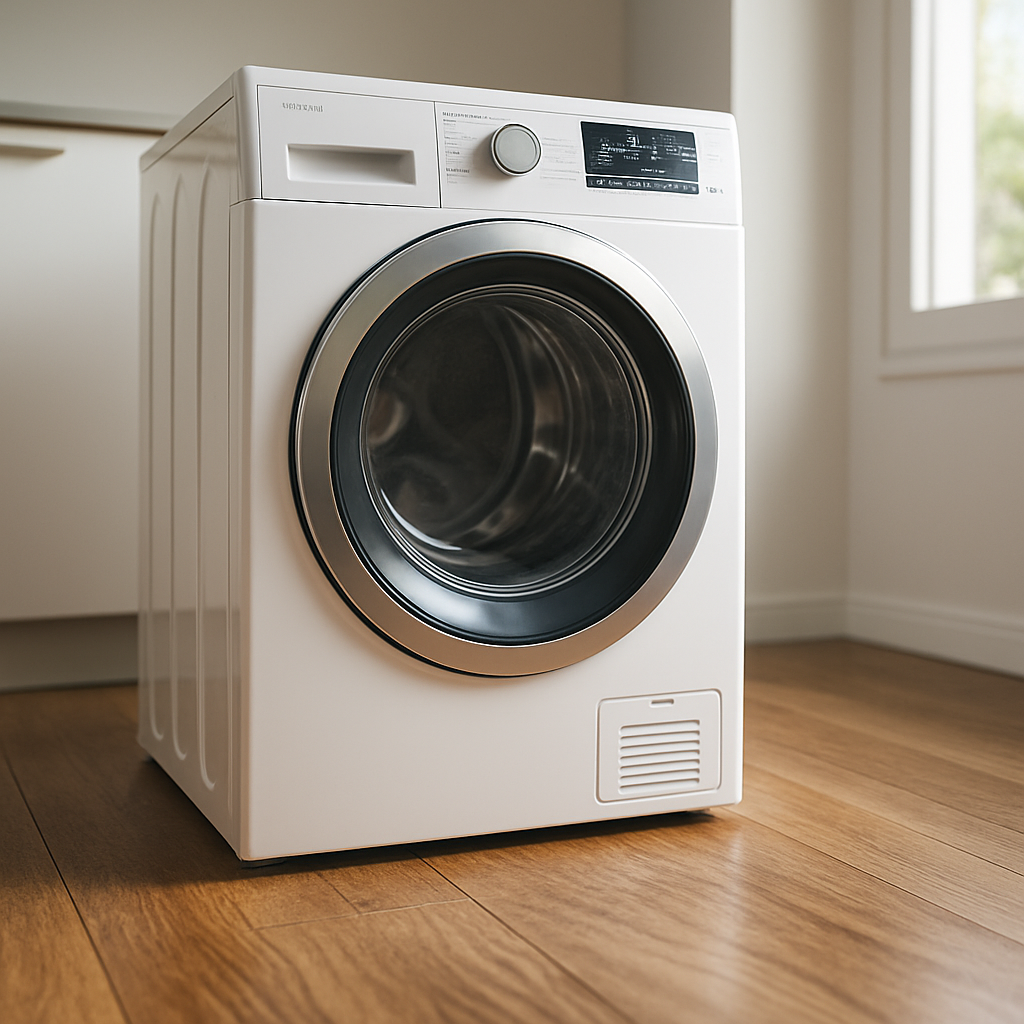
If your dryer is suddenly much louder on a hardwood floor but sounds normal elsewhere, the noise is usually floor resonance amplification. The wood floor acts like a speaker, boosting normal vibration into an annoying thump or rumble. First action: confirm it by temporarily placing a thick rubber mat or anti-vibration pads under the dryer feet. If the noise drops significantly, the dryer is likely fine and you need isolation and leveling, not parts.
Identify the Noise First
Resonance problems are often about when the noise gets louder and what changes it. Use this quick guide to match your situation.
During drum rotation
Low rumble or drumming that gets louder as the drum speeds up: common with resonance, especially on floating or springy hardwood.
Rhythmic thump every revolution that you can feel through the floor: can still be resonance, but check for an uneven load first.
High-pitched squeal or metal scraping: not a floor issue; likely internal wear.
At startup
Single heavy bang or brief thud, then quieter: cabinet shifting on slick hardwood, feet not gripping, or dryer not level.
Motor hum with no drum movement: not resonance; stop and troubleshoot separately.
During heating
Sound grows as the dryer warms: vibration can increase slightly as components expand and the cabinet changes contact with the floor. Resonance can make that change seem dramatic.
Sharp clicking or ticking near the rear with heat: may be normal thermal expansion, but resonance can amplify it.
During cooling cycle
Noise becomes more noticeable when heat shuts off: airflow sound drops, so floor-amplified vibration stands out more.
Constant
Same loudness regardless of load size and cycle: often a contact/leveling/resonance issue.
Gets worse quickly over days: more likely an internal part failing than floor resonance alone.
Intermittent
Only loud with towels/blankets or one heavy item: out-of-balance load causing extra vibration that the hardwood amplifies.
Only loud at certain drum speeds: classic resonance, where the floor and cabinet hit a vibration frequency that booms.
What This Noise Usually Means
Hardwood floors, especially floating floors or older plank subfloors, can resonate. The dryer’s normal vibration transfers through the feet into the floor, and the floor panel acts like a sounding board. That turns a normal low-frequency vibration into a louder rumble, drumming, or thudding you hear across the room. This is most noticeable when the dryer is slightly out of level, when the feet are on a slick finish, when the load is uneven, or when the dryer sits near a seam or soft spot in the floor.
Most Common Causes
Dryer not level, one foot slightly unloaded: the cabinet rocks and “hammers” the floor, which hardwood amplifies.
Feet slipping on slick hardwood finish: micro-movement makes a dull thump/rumble even if the dryer is technically level.
Resonant spot in the floor: sitting over a seam, unsupported area, or between joists where the floor flexes more.
Out-of-balance loads: extra vibration from wet towels, blankets, or one heavy item becomes much louder on wood.
Stacked washer/dryer or pedestal increasing vibration transfer: taller setup can excite the floor more.
Internal dryer vibration that was always present but now noticeable due to placement change: moved to a different room, new flooring, or different orientation can make normal vibration sound abnormal.
How to Check Safely
These checks focus on proving whether the floor is amplifying normal vibration or the dryer itself is failing. Keep hands clear of moving parts and do not remove panels unless you are qualified.
Step 1: Confirm it is placement-related. With the dryer off, push on the top corners. If it rocks, you have a leveling/contact issue that hardwood will magnify.
Step 2: Run a short test with the dryer empty. Use a timed dry or air-only cycle for 2–3 minutes. If the noise is much lower empty, the floor is amplifying an imbalance problem rather than a constant mechanical noise.
Step 3: Do a traction test. With the dryer off, try sliding it gently. If it moves easily on the finish, the feet are not gripping and will transmit thumps. This is common on glossy polyurethane floors.
Step 4: Add temporary isolation to verify resonance. Place a thick rubber anti-vibration mat under the front feet only (or use anti-vibration pads under all four feet). Re-test. A big improvement points strongly to resonance amplification.
Step 5: Re-level the dryer. Set a level left-to-right and front-to-back on the top panel. Adjust feet until the dryer is stable with no rocking. On hardwood, prioritize stability over perfectly centered bubble.
Step 6: Check load behavior. Run a typical load. If the noise spikes only when the drum is heavy and shifting, redistribute items, avoid single heavy pieces, and use a lower spin extraction on the washer if the load is coming out very wet.
Step 7: Listen for non-resonance clues. If you hear squealing, grinding, scraping, or a repeated metallic tick that does not change with mats/pads, stop and plan for an internal inspection.
When This Is Normal vs A Problem
Usually normal (floor-related):
Noise improves clearly with rubber pads or a mat.
Noise is a low rumble, drumming, or hollow thud rather than a squeal or scrape.
Noise depends heavily on load size and balance.
The dryer performs normally and does not smell hot or show error codes.
More likely a problem (not just floor amplification):
High-pitched squeal, grinding, scraping, or chirping that persists on pads.
Thump is perfectly timed with each drum revolution even with an empty drum.
Noise suddenly became extreme without the dryer being moved, and isolation makes little difference.
Visible shaking that walks the dryer forward even when level, suggesting abnormal vibration.
When to Call a Technician
Call if you hear squealing, grinding, metal-on-metal scraping, or a burning smell. Those are not floor resonance issues.
Call if the dryer walks significantly even after leveling and adding anti-vibration pads.
Call if the noise is loud with an empty drum and does not change when you isolate the feet from the hardwood.
DIY is reasonable if the noise drops substantially with pads/mat and the dryer is stable after leveling.
How to Prevent This Problem
Use proper isolation: rubber anti-vibration pads under all four feet or a dense rubber mat designed for appliances.
Level for stability: eliminate rocking; re-check after a week because feet can settle into softer floor areas.
Avoid resonant locations: if possible, shift the dryer a few inches to avoid seams or soft spots. Small moves can change resonance dramatically.
Load smart: mix heavy and light items, avoid drying one heavy blanket alone, and break up large wet clumps.
Keep feet clean: dust reduces grip on slick hardwood and increases micro-slipping noise.
Related Dryer Noise Problems
Dryer vibrates and walks forward on smooth flooring
Dryer thumps only with towels or blankets
Dryer louder after moving to a different room or new flooring
Stacked laundry center rattles more on wood than tile
Dryer makes a squeal that does not change with anti-vibration pads
Conclusion
A dryer that seems unusually loud on hardwood is often a normal vibration problem made worse by floor resonance. Prove it quickly with a rubber mat or anti-vibration pads and a leveling check. If isolation changes the sound a lot, focus on stability, traction, and load balance. If the noise stays sharp, metallic, or unchanged, plan for a technician to inspect internal wear parts.
Frequently Asked Questions
Will anti-vibration pads damage my hardwood floor finish?
Quality rubber pads usually protect the floor, but some rubbers can discolor certain finishes over time. If you are concerned, use a purpose-made appliance mat or place a thin, rigid protective sheet designed for floors under the rubber mat. Avoid soft foam that compresses and lets the dryer rock.
Why is my dryer quiet on tile but loud on hardwood?
Tile over a solid base tends to be stiff and less resonant, so it does not amplify low-frequency vibration. Hardwood, especially floating floors, can flex and act like a drumhead. The dryer may be producing the same vibration in both locations, but you only hear it strongly on the wood.
My dryer is level but still booms on the hardwood. What next?
Try changing the contact and resonance: add pads/mat, then shift the dryer a few inches left or right and re-test. Also confirm the feet are gripping and not sliding. If the boom happens only at certain drum speeds, that is typical resonance behavior and isolation is the fix.
Is a thumping sound always an out-of-balance load?
No. Hardwood resonance can turn normal vibration into a thump even with a reasonable load. However, if the thump mostly happens with one heavy item or a very wet load, imbalance is contributing. Redistribute items and avoid drying one bulky piece by itself.
If pads help a little but not enough, does that mean the dryer is failing?
Not necessarily. Some floors need a thicker isolation solution, such as a dense rubber mat plus pads, or relocating the dryer off a particularly flexible spot. If you can still hear a squeal, scrape, or grind layered on top of the rumble, that is when internal dryer service becomes likely.
So much of this feels like a relief you can’t quite name until it’s already gone. The noise thins out, the arguments lose their grip, and the page finally reads like a page.
There’s a quiet confidence in that—no fireworks, just things clicking into place. For the first time in a while, the whole subject doesn’t take up residence in your head.