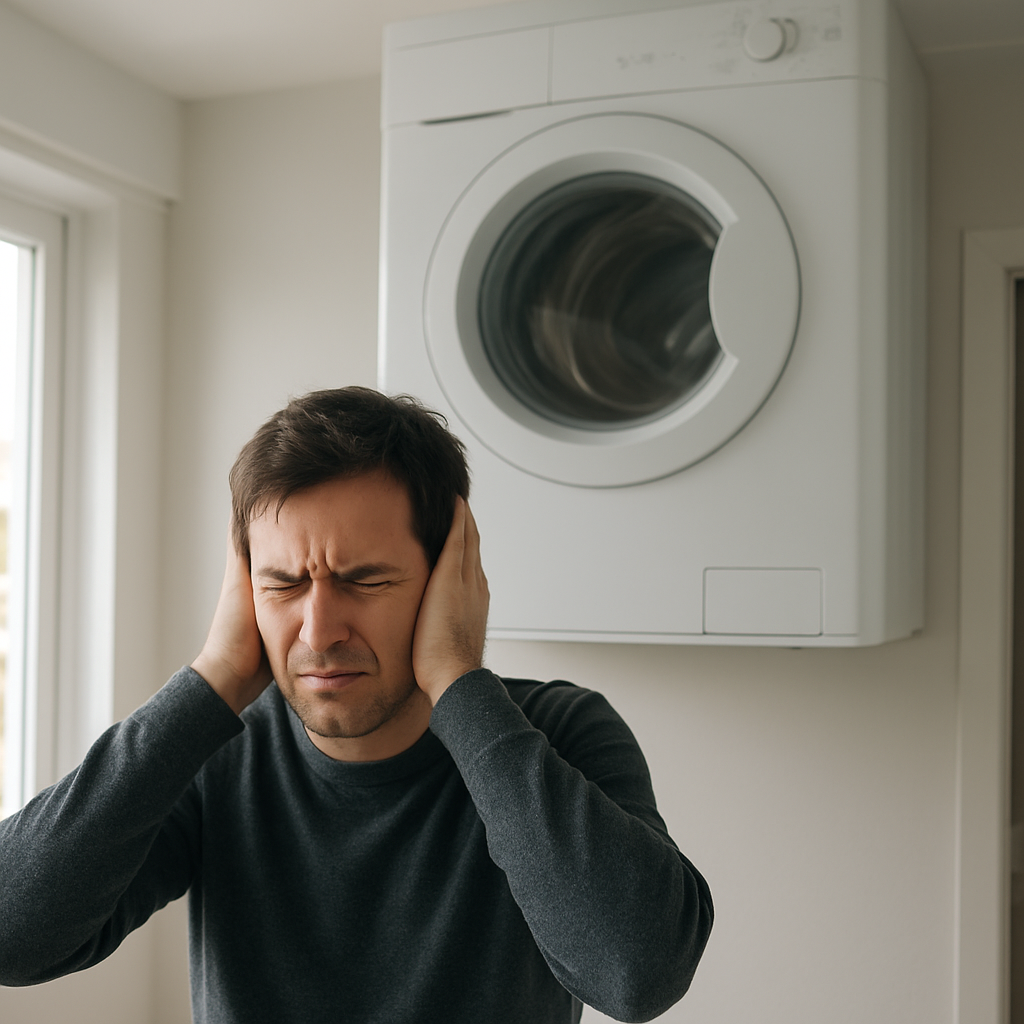
If your dryer sounds much louder upstairs than it does in the laundry room, the noise is usually being amplified by structural vibration transmission, not a failing dryer. Most often the machine is slightly out of level, sitting on a resonant floor, or touching a wall/trim so vibrations transfer into joists and drywall. First action: pull the dryer 1–2 inches off any wall, confirm all four feet are firmly on the floor, then level it and test again.
Identify the Noise First
Use this guide to match what you hear to a vibration-transfer problem versus a true internal mechanical failure.
During drum rotation (most common): A low rumble, thump, or droning that is louder in upstairs rooms than beside the dryer points to the floor acting like a speaker. If the sound is a sharp squeal or scraping beside the dryer, that is less likely structural and more likely internal.
At startup: A brief heavy bump right as the drum begins turning often means the cabinet shifts slightly, then locks into a vibration path through the floor or wall. If it clunks repeatedly for 5–10 seconds, suspect an unbalanced load first.
During heating: A louder booming or drumming only when heat is on can happen when the exhaust duct expands and touches framing, or the dryer vibrates against the vent connection, sending vibration into the wall cavity.
During cooling cycle: If the upstairs noise drops noticeably during cool-down, that supports vibration amplification (heat can change duct contact points and cabinet resonance). If the noise continues unchanged, focus on leveling and isolation points.
Constant: A steady hum/rumble that travels far through the house often means the dryer is rigidly coupled to the building (hard contact with wall, floor flex, missing rubber foot pads).
Intermittent: Noise that comes and goes with certain loads or drum positions suggests load imbalance or the dryer rocking on one foot, creating intermittent hard contact points that transmit vibration.
What This Noise Usually Means
Upstairs noise complaints are commonly caused by structure-borne vibration. The dryer’s normal operating vibration is being transferred into the home through direct contact points, then amplified by floor joists, subfloor, wall studs, and ducting. A dryer can sound acceptable in the room yet seem loud upstairs because the building carries low-frequency energy more efficiently than air noise.
The diagnostic goal is to find where the dryer is coupling to the structure: out-of-level feet, cabinet contact with wall or baseboard, a rigid vent pushing the dryer into framing, or a flexible/weak floor section acting as a soundboard.
Most Common Causes
Dryer not level or rocking: One foot not firmly planted makes the cabinet “tap” the floor each rotation, sending vibration into joists.
Dryer touching a wall, baseboard, or trim: Even light contact turns the wall into a vibration panel.
Vent duct pushing the dryer forward or sideways: A stiff or poorly routed vent can force the cabinet into the wall or make the dryer sit twisted, increasing vibration transfer.
Floor flex under the dryer: Laundry areas over open spans, older subfloors, or uneven underlayment can amplify low-frequency rumble.
Washer/dryer pedestals or stacked setups transmitting vibration: Pedestals can resonate, and stacking can increase mass and transfer into framing.
Hard feet on a slick surface: Some floors (tile, laminate) allow micro-sliding that becomes a low rumble upstairs.
Abnormal internal vibration (less common for the upstairs symptom): Worn drum support parts can create extra vibration that the structure then amplifies. If isolation steps do not change the noise, this moves up the list.
How to Check Safely
These checks focus on isolating the dryer from the structure. Do not remove panels unless you are qualified, and do not run the dryer with the lint duct disconnected indoors.
Step 1: Confirm the noise is structural. Stand next to the dryer while it runs, then have someone listen upstairs. If it’s much louder upstairs than beside the dryer, prioritize vibration transmission fixes.
Step 2: Create clearance. Turn the dryer off. Pull it forward so nothing touches the wall, baseboard, shelves, or the washer. Aim for at least 1 inch clearance on sides/back where possible.
Step 3: Check for rocking. With the dryer off, press on opposite corners of the top panel. If it rocks or clicks, at least one foot is not firmly planted.
Step 4: Level the dryer. Use a small level front-to-back and side-to-side. Adjust the feet so all four contact points are solid. Re-check rocking after each adjustment.
Step 5: Inspect the vent connection for forcing or contact. Look behind the dryer with a flashlight. If the vent is kinked, smashed, or pushing the dryer sideways, re-route it so it sits relaxed without shoving the cabinet into the wall. Use a proper flexible dryer duct and avoid a tight 90-degree pinch right at the outlet.
Step 6: Test with an evenly distributed load. Run the dryer with a medium load of similar-weight items. Single heavy items can create imbalance that mimics a structural problem.
Step 7: Add isolation under the feet. If leveling and clearance help but noise still travels upstairs, place dense anti-vibration pads under each foot. Use pads designed for appliances, not soft foam that can let the dryer wobble.
Step 8: Identify floor resonance. If pads improve it only slightly, the floor may be acting like a drum. Move the dryer a few inches to change the load point on the floor and retest. A small relocation can reduce resonance dramatically.
When This Is Normal vs A Problem
Usually normal: A steady low hum while running, slight vibration you can feel on the cabinet, and moderate sound in the laundry room. If the machine dries normally and the sound changes noticeably when you level it or pull it off the wall, you are dealing with transmission, not a failing dryer.
Likely a problem: The dryer walks forward, bangs repeatedly, or the vibration is strong enough to rattle nearby doors even after leveling and adding clearance. Also concerning are sounds that are clearly mechanical at the dryer itself: metal scraping, sharp squealing, or rhythmic grinding that does not change with load size or isolation pads. Those point to internal wear creating excessive vibration that the structure then amplifies.
When to Call a Technician
Call for service if: the dryer remains loud at the machine after leveling/clearance/pads, or you hear squealing, scraping, or grinding directly from the cabinet.
Call for vent help if: correcting the vent routing is not straightforward, the duct is crushed inside a wall, or you suspect the vent path is restricted. Vent issues can force awkward positioning that increases vibration and can also affect drying performance.
Consider a contractor if: the floor under the dryer is visibly flexing, the laundry area is on a weak span, or structural resonance persists despite proper leveling and isolation. Sometimes the building, not the appliance, is the amplifier.
How to Prevent This Problem
Keep the dryer level and re-check after moving it for cleaning.
Maintain clearance so the cabinet and vent do not touch framing, trim, or the washer.
Use a vent setup that doesn’t push the dryer around. Avoid tight kinks; keep the connection relaxed and centered.
Use quality anti-vibration pads if the laundry area is above living space or on a resonant floor.
Load for balance. Mix items so the drum doesn’t develop a single heavy lump that adds vibration.
Related Dryer Noise Problems
Dryer rumbling only when installed, quiet when pulled out (cabinet or vent contact transmitting vibration)
Dryer thumping with bulky items (load imbalance mistaken for mechanical failure)
Dryer vibrating and walking forward (leveling/foot contact problem creating hard impulses into the floor)
Dryer makes a droning noise through a shared wall (wall contact or vent contact turning studs into a sound path)
Dryer louder after vent cleaning or replacement (new duct routing pushing the dryer into a resonant contact point)
Conclusion
If your dryer is loud upstairs, treat it as a vibration transmission issue first: remove wall contact, eliminate rocking by leveling the feet, and make sure the vent is not forcing the dryer into the structure. Then add isolation pads if needed. If the dryer is still loud at the cabinet or the sound is a squeal/scrape/grind, schedule service to check internal supports.
Frequently Asked Questions
Why is my dryer louder upstairs than in the laundry room?
Low-frequency vibration can travel through joists and studs more efficiently than through air. If the dryer is slightly out of level or touching a wall or vent, the building carries and amplifies the vibration, making it seem much louder upstairs.
Will anti-vibration pads fix a dryer that is loud upstairs?
They often help, but pads work best after the dryer is properly leveled and not touching anything. Pads reduce vibration transfer through the feet; they do not fix a dryer that is rocking, being pushed by the vent, or making an internal grinding/squealing noise.
How much space should be behind the dryer to reduce vibration noise?
Enough that the cabinet and vent connection are not touching the wall or baseboard and the vent is not kinked. In most setups, 1–2 inches of relaxed clearance is a good target, but the real requirement is zero contact under vibration.
My dryer only gets loud upstairs when heating. What should I check?
Check the vent path and connection first. Heat can change how the duct sits and can create contact with framing or the wall, which becomes a vibration path. Confirm the duct is not rigidly braced against studs and is not pushing the dryer into the wall.
When does upstairs noise mean the dryer itself is failing?
If the dryer is loud right at the machine and the sound is a sharp squeal, metal scrape, or grinding that doesn’t change when you level it, pull it off the wall, or change loads, suspect internal wear. At that point, a technician should confirm drum support components and any source of excessive vibration.
What used to feel like noise now reads like something you can actually move past. The air clears, the clutter settles, and the conversation doesn’t have to keep circling the same point.
There’s room again—for work, for rest, for the little things that don’t require a full argument. Not every problem disappears, but this one stops taking up the chair at the table.