Sump Pump Loud During Rain? Normal Operation Or Warning Sign?
Quick Answer (Most Likely Cause)
Most loud sump pump noise during rain is caused by high-load operation creating cavitation at the inlet or vibration resonance in the discharge pipe. First action: watch the sump during a heavy run and listen where the sound is loudest (pit vs discharge line). If the pump is not lowering water level, runs continuously without keeping up, or the pit is close to overflowing, stop relying on it and call a technician.
Identify the Noise First
Correct diagnosis starts with timing. Match your noise to one of these operating moments.
At startup only: brief clunk, thump, or rattle as the pump torques and the check valve reacts.
Only during heavy rain/high inflow: louder than normal whoosh/gravelly sound, sharper vibration in pipes, or a buzzing that gets worse as water level drops fast.
During continuous run: steady hum with vibration, or a rough growl that changes pitch as flow changes.
Humming but not pumping: motor hum with little/no water movement (urgent).
After recent installation or plumbing work: new resonance in the discharge line, louder check valve action, or pipe contact vibration.
When the pump stops: bang or slam in the discharge (check valve or water hammer related).
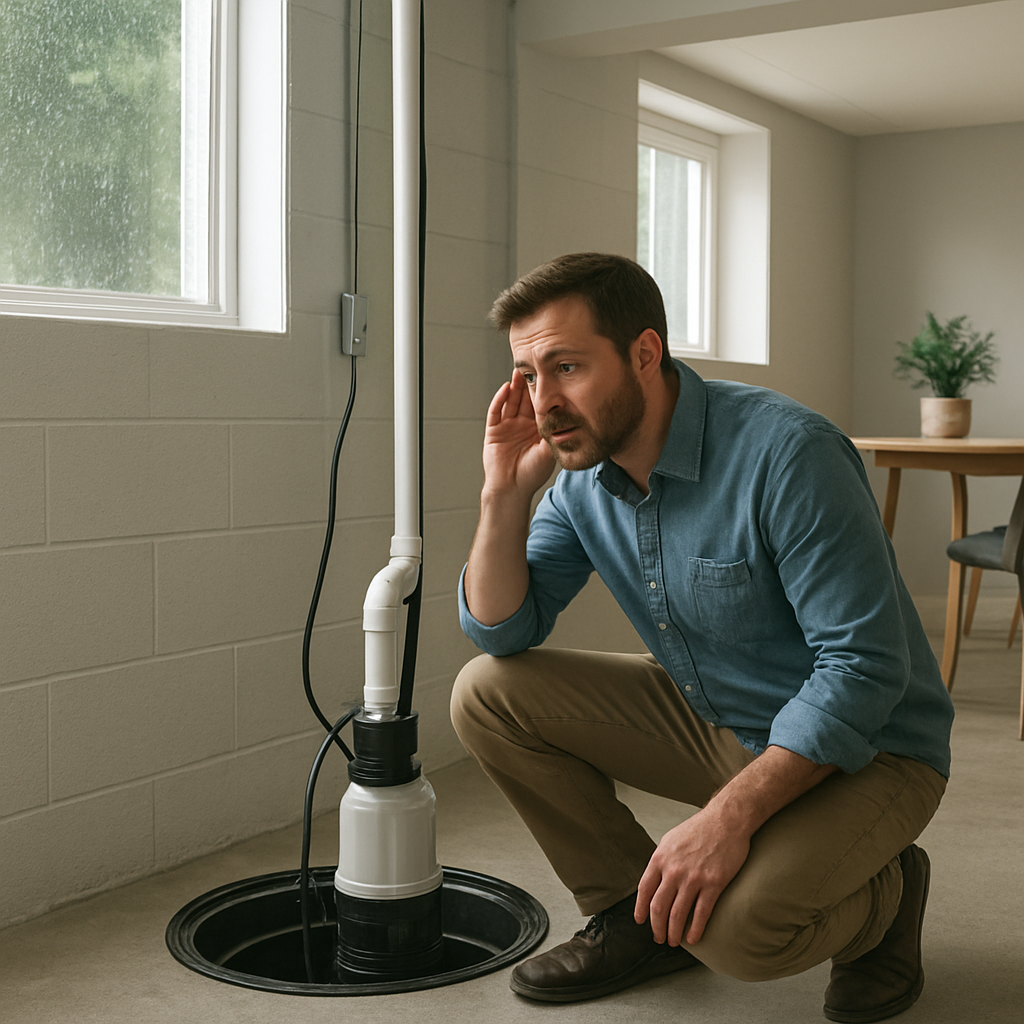
Next, locate the loudest point. Put your ear near (not inside) the pit cover, then near the vertical discharge pipe, then along the horizontal run. Cavitation is usually loudest at the pump/pit. Pipe resonance is usually loudest along the discharge line or where it touches framing.
What This Noise Usually Means
During heavy rain the pump is asked to move maximum water for long periods. That high-load flow can create two common noise mechanisms.
Cavitation at the pump inlet: When water is turbulent, dropping too low near the intake, restricted by debris, or the pump is moving water faster than the pit refills smoothly, low pressure forms vapor bubbles at/near the impeller. Those bubbles collapse as pressure recovers, making a gravelly, rattling, or growling sound and causing vibration.
Pipe vibration resonance: High flow through the discharge line can shake the pipe. If the pipe is loosely supported, touching joists, or has hard contact points, the vibration transfers into the structure and becomes much louder than the pump itself. This often shows up only during heavy rain because flow and velocity are higher.
These are often not immediate failures, but they are warnings of strain. Long high-load operation with cavitation or resonant vibration accelerates check valve wear, loosens fittings, and can damage the impeller or motor bearings over time.
Most Common Causes (Ranked by Probability)
1) Discharge pipe vibration transferring into framing: High storm flow shakes the discharge line; the pipe contacts wood, concrete, or a hanger and amplifies noise. Sound: loud drumming, buzzing, or rattling along the pipe run. Clue: you can feel strong vibration by lightly touching the pipe, and noise is louder away from the pit.
2) Cavitation from high drawdown in a small pit: The pump lowers the water faster than it refills around the intake, creating turbulence/air mixing at the impeller. Sound: gravelly growl or harsh rattling from the pit. Clue: the water level drops very quickly and you see swirling/vortexing near the intake.
3) Partial obstruction at the inlet screen or impeller (debris/sediment): Debris reduces inlet area and increases velocity and turbulence, triggering cavitation under load. Sound: rough grinding/growl that worsens under heavy flow. Clue: slower pumping rate than usual, more frequent running, visible debris in the pit.
4) Check valve reacting violently at high flow: A worn or incorrect valve can flutter or slam when flow is high. Sound: rapid clicking/chatter during run or a strong bang at stop. Clue: noise is loudest near the check valve and changes as the pump transitions on/off.
5) Discharge line restriction or poor routing increasing load: Frozen section, clogged elbow, undersized pipe, or excessive fittings increases backpressure. Sound: louder motor tone, harsher vibration, sometimes surging. Clue: weaker discharge outside, water level drops slowly even though the pump sounds strained.
6) Motor electrical hum that is being amplified by vibration (not an electrical failure by itself): Normal motor hum becomes loud when the pump or piping resonates against the basin or framing. Sound: steady hum with strong vibration. Clue: hum volume changes when you steady the discharge pipe (without forcing it) or when you temporarily add padding at a contact point.
7) True electrical source noise from a failing motor/starting components: A failing motor winding, capacitor (if equipped), or internal switch can create an abnormal buzz and reduced torque. Sound: harsh buzz, slower start, sometimes followed by a thermal shutoff. Clue: pump struggles to start, trips, or runs hot, especially under storm load.
8) Internal mechanical wear (bearings/impeller): Wear makes the pump louder when heavily loaded. Sound: metallic grinding, squeal, or persistent roughness regardless of water level. Clue: noise is present even at moderate inflow, and performance is declining.
How to Check Safely
If the pit is close to overflowing, do not spend time diagnosing. Call for service or deploy backup pumping. For routine checks, keep hands clear of moving parts and do not open wiring compartments.
1) Confirm it is pumping effectively: During operation, the water level should drop steadily. If level is not dropping or rises while running, treat as urgent.
2) Locate the noise source: Listen at the pit cover, then along the discharge pipe, then at the check valve. If the loudest point is the pipe run, suspect resonance/support issues first.
3) Check discharge pipe contact points: Look for the pipe touching joists, wall studs, or the basin lid. Lightly press near (not on) a contact point; if the sound changes, vibration transfer is likely.
4) Observe for vortexing and air draw: With the pump running, look for a spiral/vortex above the intake or slurping air. That supports cavitation or pit geometry issues.
5) Inspect the pit for sediment and debris: With the pump off and water calm, use a flashlight to check for stones, silt, or debris around the intake. Do not reach into the water if you are not certain power is disconnected.
6) Check the discharge outside: Verify strong flow at the outlet during operation. A weak outlet stream during loud operation suggests restriction/backpressure.
7) Quick check valve assessment: If you hear repeated chatter during the run or a hard slam at shutoff, the check valve may be installed incorrectly, sticking, or undersized.
8) Electrical safety checks only: If the pump trips a breaker, needs repeated resets, or hums without moving water, stop using it and call a technician. Do not keep cycling power.
Normal Operating Sound vs Warning Signs
✔ Normal: Brief startup thump and a steady smooth whoosh while pumping, with only mild vibration in the discharge pipe.
✔ Normal: One solid check valve click at stop, not a repeated chatter.
✔ Normal during heavy rain: Louder overall sound proportional to longer run time, but the pump keeps up and the water level drops reliably.
Warning: Gravelly, rattling, or growling from the pit that gets worse as the water level drops fast. This is typical of cavitation and high-load turbulence.
Warning: Loud drumming/buzzing that is clearly louder on the discharge pipe or in the floor joists than at the pit. This indicates pipe vibration resonance and can loosen fittings over time.
Warning: Rapid clicking/chatter near the check valve during the run or repeated banging at shutoff. This can lead to backflow and short cycling.
Warning: Humming with little/no water movement, slow start, or the pump stops and restarts on a thermal overload. This points to strain or electrical/motor issues and needs service.
Warning: Pump runs continuously during rain but the water level barely drops or rises. This is a performance problem, not just noise.
When Professional Service Is Recommended
Pump cannot keep up: water level rises during operation, or the pit approaches overflow.
Humming but not pumping: motor runs but water does not move, or it starts slowly.
Breaker trips or repeated resets: any electrical protection event is a stop-and-call condition.
Persistent cavitation sound: gravelly/growling noise repeats every heavy rain and does not improve after debris removal and basic pit cleaning.
Excessive structural vibration: discharge piping shakes the building, fittings loosen, or you see pipe movement at joints.
Check valve chatter or slam that continues: especially if it causes short cycling or backflow noise after shutoff.
Reduced discharge flow: indicating line restriction, freeze damage, or improper pipe sizing/routing.
How to Prevent This Problem
Secure and isolate discharge piping: add proper pipe supports and keep the pipe from hard-contacting joists or walls; use appropriate isolation where permitted.
Keep the pit clean: remove silt and debris that can obstruct the intake and trigger cavitation under high flow.
Verify proper pit size and pump match: a pump that draws down too aggressively in a small pit is more prone to vortexing and cavitation during storms.
Maintain a correct check valve setup: correct orientation and sizing reduces chatter, backflow, and hammer.
Confirm discharge routing and outlet condition: avoid restrictions, excessive elbows, or crushed/blocked outlet sections; ensure the exterior outlet is not buried or frozen in winter.
Test under load before storm season: run water into the pit to verify smooth operation, strong discharge, and acceptable vibration levels.
Consider a battery backup or secondary pump: reduces continuous high-load strain on one pump during extreme inflow and provides redundancy.
Related Water & Pump Noise Problems
Sump pump hums but does not discharge water
Sump pump loud clunk when it shuts off
Sump pump short cycles during wet weather
New sump pump is louder than the old one
Discharge pipe rattles inside the wall during pumping
Check valve chatter during pump run
Sump pump runs continuously after heavy rain
Water heater popping after years of use (sediment release noise)
Water heater ticking right after heating cycle (expansion noise)
Pipe banging near a water heater after a heating cycle (vibration transfer)
Conclusion
If your sump pump is loud mainly during rain, the most likely cause is high-load flow creating cavitation at the pump inlet or amplifying vibration resonance in the discharge piping. The next safe step is to confirm the pump is keeping up, then pinpoint whether the noise is loudest at the pit (cavitation/obstruction) or along the discharge line (pipe vibration/support issue).
Frequently Asked Questions
Is a loud sump pump during heavy rain unsafe to run?
If it is pumping strongly and the water level drops normally, it is usually not an immediate safety issue. If the pump hums without moving water, trips a breaker, overheats (shuts off and restarts), or the pit is close to overflowing, stop relying on it and call for service.
What can I do right now to make it quieter during a storm?
Safest temporary mitigation is reducing pipe-to-structure contact: confirm the discharge pipe is not hard-touching joists or the basin lid and add temporary padding at a contact point if accessible. Do not restrict the discharge flow. If the noise is a gravelly growl from the pit, focus on keeping the pump running effectively and schedule debris cleaning and inspection.
How much does it typically cost to fix a noisy sump pump?
Common fixes like adding pipe supports or replacing a check valve are often lower-cost service calls plus parts. Cleaning the pit and clearing minor obstructions is also typically modest. If the pump has internal wear or electrical failure and needs replacement, total cost is higher due to the pump, labor, and any discharge rework.
How do I tell true electrical noise from vibration amplifying normal motor hum?
True electrical-source noise is a harsh buzz often paired with poor starting, low torque, tripped breakers, or thermal shutdown. Vibration-amplified hum is a steady motor tone that becomes much louder when the discharge pipe or basin transmits it into framing; it often changes noticeably when pipe contact points are steadied or isolated.
Should I repair or replace the pump if it only gets loud during rain?
If the pump keeps up and the noise is mainly pipe resonance, repair is usually appropriate (support/isolation, check valve tuning, discharge routing). If you have persistent cavitation sounds, declining pumping performance, repeated overheating, or any electrical trip events, replacement is often the better reliability choice after a technician verifies the pit, discharge, and sizing are correct.
That’s the whole trick: the problem stops taking up space in your head, and the fix no longer feels like a distant concept. There’s a quiet relief in watching it click into place, like a door finally closing on its own.
Now it’s just living with the aftermath—lighter mornings, fewer pauses, and that odd sense of “oh, right” when you realize how much time you used to spend negotiating with the issue. The noise fades; the day keeps going.