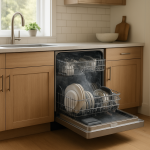

Dishwasher Noise During Circulation: Causes & Fixes
Quick Answer
Most circulation-phase noise is caused by hydraulic turbulence in the wash circuit: aerated water, a partial restriction, or a spray path hitting a surface creates a rushing, growling, or “water hammer” sound. It happens when the circulation pump is moving high flow through a narrowed or disrupted path. First action: confirm the noise only occurs during spray/circulation by pausing the cycle (opens lid) and restarting; if the sound starts exactly when spraying resumes, troubleshoot the spray path and circulation intake for restriction or air.
Identify the Noise First
Match the sound to the exact phase. Listen with the kitchen quiet and note when the sound begins relative to cycle events.
- During water fill: steady inlet hiss or valve buzz; if your noise starts before any spraying, it is not circulation turbulence.
- During spray / circulation: whoosh/roar, growl, “chattering water,” pulsing surges, or a rhythmic thump that tracks spray arm rotation.
- During draining: higher-pitched whine and gurgle at the sink/disposal; not this topic.
- During heating: light ticking/creaking from metal expansion; not this topic.
- At start of cycle: brief prime sounds are normal; persistent noise after the first minute points to a circulation-path issue.
- At end of cycle: mostly drain and fan sounds; not circulation turbulence.
- Constant: if it continues when the door is opened or when spray stops, it is not active circulation.
- Intermittent: if it pulses with spray bursts or changes when the arms index, it usually is flow disruption in the spray circuit.
Isolation method: open the door during the noise. If the noise stops immediately and returns the moment spraying resumes, you’re in the circulation stage and the sound is coming from turbulent flow in the wash circuit.
What This Noise Usually Means
Active circulation noise comes from unstable flow inside the hydraulic circuit: the circulation pump accelerates water through the sump, filters, passages, and spray arms. If the circuit ingests air, has a partial blockage, or is forced through an uneven restriction, the flow becomes turbulent and can cavitate. Turbulence creates a loud rushing/roaring sound; cavitation adds a gravelly growl; pulsing restrictions create surging or thumping as pressure builds and releases. Unlike a pure motor bearing noise, turbulence changes quickly with water level, load placement, and spray arm position.
Most Common Causes
- Spray arm jets partially blocked (scale, seeds, labels): restricted jets raise pressure and create noisy, unstable flow; can also make the sound pulse as the arm rotates and load intermittently deflects spray.
- Filter/sump area restriction: debris at the fine filter, intake screen, or sump channel forces the pump to pull through a narrowed path, increasing turbulence and creating a growling “strained water” sound.
- Air entrainment from low effective water level: not a fill-system diagnosis here; during circulation the pump can ingest air if water is being displaced by tall items, heavy foaming, or a momentary slosh away from the intake, producing a rattly/growly cavitation sound that changes with load and cycle action.
- Spray arm striking or spraying directly into a dish surface: a steady thrum or hammering as the jet hits a flat pan or the arm taps an obstruction; sound is position-dependent and often rhythmic.
- Wash manifold/diverter path partially restricted (if equipped): turbulence increases when flow is routed through a narrower or obstructed channel; noise may change tone when the machine shifts between lower/upper/mid spray circuits.
- Hard-water scale inside spray arm or feed tube: reduces cross-section and roughens passages, raising turbulence and making a louder whoosh even with clean filters.
How to Check Safely
These checks stay within the wash/circulation circuit. Do not run the machine with panels removed or reach into moving parts.
- 1) Confirm cycle stage: Start a cycle and wait for the first spray to begin. When the noise occurs, open the door. If the sound stops instantly and returns when you close the door and spraying resumes, proceed with circulation checks.
- 2) Isolate load factor: Run a short test with the dishwasher half-empty: no large pans, no tall cutting boards, nothing below the lower spray arm plane, and nothing protruding into the upper arm. If the noise drops sharply, turbulence is being created by spray deflection or arm interference.
- 3) Inspect spray arms: With power off at the control (and ideally the breaker if you’ll remove parts), remove the lower arm (and upper if accessible). Check for cracked seams, warped arms, and plugged jets. Flush with hot water; use a toothpick or soft pick to clear jets without enlarging them. Verify arms spin freely by hand and do not contact racks or dishes.
- 4) Confirm or rule out obstruction at filters/sump intake: Remove and clean the fine filter and screen as designed for your model. Look for glass, labels, and fibrous debris that can flutter and create pressure pulsing. Reinstall correctly; a mis-seated filter can create noisy turbulence and poor spray.
- 5) Controlled test: Reassemble and run a circulation segment. Listen for a change exactly when spray routing changes (if your model alternates zones). If the noise only occurs on one zone, focus on that arm, feed tube, and manifold path for restrictions or misalignment.
When This Is Normal vs A Problem
Normal: a steady, smooth “whoosh” during spraying; occasional soft ticks as spray hits the tub; brief loudness right as circulation starts while air is purged from the circuit (first 10–30 seconds).
Problem: gravelly growl that comes and goes (often cavitation); repeated surging/hammering that tracks arm rotation; sudden loud roaring that started after a recent loading change or after a wash with heavy food debris; a noise that changes markedly when switching rack load or when spray zone changes. Any of these typically indicate turbulence caused by restriction, air ingestion, or spray deflection rather than a normal wash sound.
When to Call a Technician
- Noise persists after cleaning filters and spray arms and after a half-empty test load rules out dish interference.
- Noise is zone-specific and you cannot access the feed manifold/diverter path to check alignment or internal restriction.
- Circulation is loud and washing performance drops (poor soil removal, detergent not dissolving), indicating a persistent hydraulic restriction or pump cavitation condition that needs deeper inspection.
- Noise escalates quickly from normal to harsh within one or two cycles; turbulence can be a symptom of an obstruction lodged deeper in the wash circuit.
How to Prevent This Problem
- Rinse off labels, toothpicks, seeds, and bone fragments that commonly lodge in spray arm jets and filter passages.
- Clean the filter on a schedule appropriate for your soil level; a partially loaded filter increases turbulence and surging.
- Load to protect spray paths: keep large flat pans from facing spray jets at close range; avoid blocking arm rotation and avoid tall items that create a “wall” the spray continuously impacts.
- Control foam: use the correct detergent type and amount; excess suds aerate the wash water and can cause cavitation-like growl during circulation.
- Address hard water buildup with periodic dishwasher-safe descaling to keep spray passages and jets from narrowing.
Related Dishwasher Noise Problems
- Rhythmic clicking only when the spray arm turns (arm contacting a utensil or rack tine, creating impact noise that mimics turbulence).
- Loud whoosh only on the upper rack wash (upper feed tube/manifold misalignment or upper arm restriction).
- Growling that comes and goes with heavy suds (aerated circulation flow from over-detergenting).
- Pulsing “pressure surge” sound during wash (filter partially blocked causing periodic flow starvation and recovery).
- Sudden roaring after cleaning (filter not seated, allowing bypass turbulence and unstable intake flow).
- Hammering when a large pan is loaded in front (spray jet impingement on a flat surface causing hydraulic thrum).
Conclusion
If your dishwasher gets loud specifically during spraying, the most common cause is hydraulic turbulence in the circulation path from a restricted spray arm/filter area or aerated flow. Confirm it’s truly circulation by stopping the cycle when the noise happens, then focus on spray arm jet blockage, filter/sump restrictions, and load-related spray deflection. If cleaning and a controlled half-load test don’t change the sound, the restriction may be deeper in the wash routing and is worth a technician visit.
Frequently Asked Questions
Why does the noise change when the spray switches between top and bottom?
That points to turbulence in one specific circulation branch. When flow is routed to a particular arm or manifold, any restriction or misalignment in that path increases velocity and instability, changing the sound. Compare the arms: the noisy zone often has more plugged jets, scale, or a feed connection that isn’t seated squarely.
Can a dishwasher sound like gravel during washing but still clean?
Yes, early on it can still clean because average flow may be adequate even while the pump intermittently ingests air or fights a partial restriction. The gravelly tone is a warning sign of unstable hydraulic conditions. Over time it typically gets louder and cleaning performance drops as the restriction worsens or the aeration becomes more frequent.
How do I tell turbulent water noise from a bad circulation motor?
Turbulence changes with loading, water condition (foam), and spray routing, and it stops instantly when the door is opened. A motor/bearing noise is more steady in tone, less sensitive to load changes, and may have a consistent electrical hum character. If cleaning the spray arms/filters and running a half-empty test makes no difference, motor or internal routing issues become more likely.
Why did the noise start right after I cleaned the filter?
The most common circulation-related reason is a mis-seated filter or screen creating an uneven intake path. That can produce a loud rushing or surging sound and may also reduce spray strength. Remove and reinstall the filter carefully, ensuring it locks and sits flat with no gaps or warped edges.
What quick test best confirms it’s a spray-path issue?
Run a short cycle with both racks mostly empty and no large flat items, then listen through the first two minutes of active spraying. If the noise is reduced or disappears, the turbulence was being triggered by spray deflection or arm interference. If it stays the same, focus on restrictions inside the spray arms, filters, and circulation passages.
What’s left now isn’t figuring anything out—it’s noticing how the pieces finally line up. The noise fades, the to-do list stops shadowboxing, and life gets a little room back.
There’s a quiet kind of relief in that. Not fireworks, just a steadier day where things feel less like a chore and more like they’re supposed to.